FORMAT
Remote, mentored
OUTCOME
Junior ML/AI engineering readiness
LANGUAGE
English
DURATION
13 weeks, part-time
FORMAT
Remote, mentored
OUTCOME
Junior ML/AI engineering readiness
LANGUAGE
English
DURATION
13 weeks, part-time
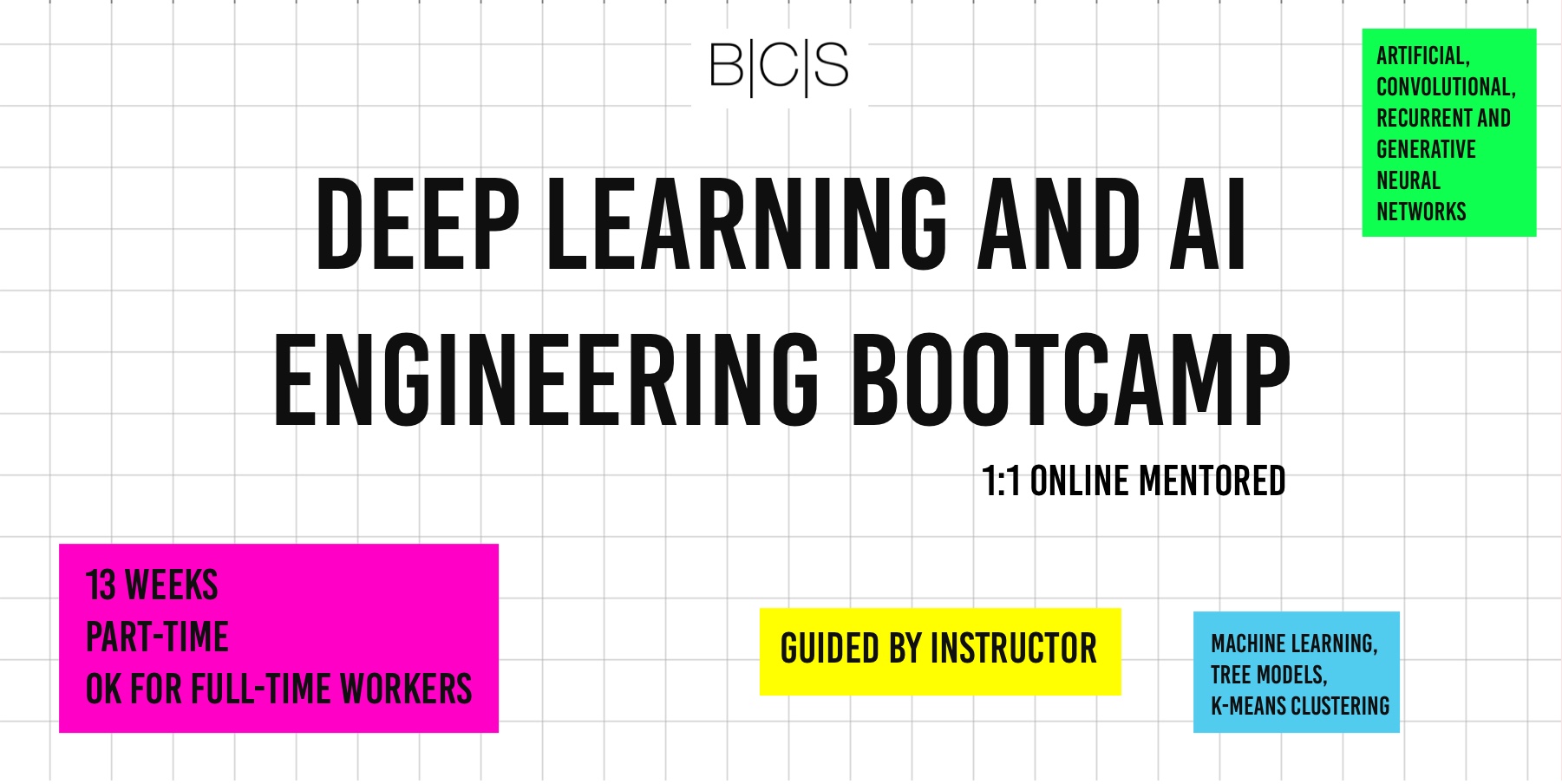
Start with the foundations — data, classical ML, neural networks — and build all the way up to fine-tuning open-source LLMs, building RAG systems, and deploying models to the cloud.
You will understand why models work, not just how to call an API. That is the difference between someone who uses AI tools and someone who builds them.
Your instructor reviews your code, answers your specific questions, and keeps you unblocked. This is what separates mentored learning from self-study with a certificate at the end.

Minerva holds a PhD from the University of Cambridge, an MPhil from the School of Geography and Environment, and an MSc from the Department of Engineering at Oxford University.
With more than a decade of academic research and mentoring experience, she brings deep practical knowledge in machine learning, deep learning, NLP, LLMs, and data science with Python and R.
She has contributed to peer-reviewed journals including PLOS One, reviewed for journals such as Remote Sensing, and given guest lectures at events like Open Data Science Conference.
After the bootcamp you will be ready to start applying for junior roles such as:
Reinforce Python fundamentals and master the core data tools: NumPy, Pandas, Matplotlib, and Seaborn.
By the end of this module you will be able to load, clean, explore, and visualize real datasets — the foundation every ML engineer builds on.
Learn the core machine learning algorithms that every AI engineer should understand: supervised and unsupervised learning, tree-based models, K-means clustering, and model evaluation with Scikit-Learn.
Get to grips with how neural networks actually work — gradient descent, backpropagation, and optimization. Build and train multilayer perceptrons with Keras.
Project: classify handwritten digits with the MNIST dataset.
Work with CNNs for computer vision and RNNs for sequential data. Learn transfer learning with ResNet50.
Real project: end-to-end ship detection in satellite imagery — from exploratory data analysis and traditional computer vision through to a custom CNN and ResNet50 transfer learning model.
Understand self-supervised learning and build generative models from scratch. Cover autoencoders, variational autoencoders (VAEs), and denoising networks.
Project: image denoising with autoencoders.
The deepest module in the course. Start with NLP foundations using SpaCy — entity recognition, pipelines, keyword extraction, and text similarity — then move into the modern LLM stack.
You will work with the OpenAI API, load and run open-source models via Hugging Face (including Mistral), build AI applications with LangChain and LlamaIndex, and implement full RAG pipelines with embeddings and vector retrieval.
The module also covers prompt engineering, LLMOps, model deployment on GCP, quantization, and fine-tuning with SGD — everything needed to move from experimenting with LLMs to deploying them.
Build a project of your own choosing in the domain that interests you most — computer vision, NLP, LLM applications, or generative models. Your instructor will help you scope it, review your work, and push you to make it something you can show to a hiring manager.
Let's have a discovery call to see which training is better for you and your goals.
Or just call us: +34 936 639 807
Python: We provide a Python video course that starts from the basics and goes to an advanced level. It includes around 7 hours of lessons and about 100 exercises with tests — so if you are new to Python, you will be ready before the bootcamp begins.
900€ paid upon registration, the remaining is due before the course begins.
Comparable 1:1 mentored AI programs at other schools cost €8,000–€15,000. At BCS you get a Cambridge-trained researcher, a modern LLM-focused curriculum, and a low student-to-mentor ratio — at a fraction of that price.
We can assist in getting a student loan which usually has lower rates than consumer loans.
We can send you a proforma invoice for the selected course to attach to the application.
Please fill out this form.
Instalment payments are available at the checkout by  and
and  .
.
Format: online
Tuition: 3950€
Become an ML/AI Engineer in 13 weeks
13-week course, online, mentored, in English, part-time.
Registration prepayment 900€.
Format: online
Tuition: 3950€
Become an ML/AI Engineer in 13 weeks
13-week course, online, mentored, in English, part-time.
Registration prepayment 900€.
Format: online
Tuition: 3950€
Become an ML/AI Engineer in 13 weeks
13-week course, online, mentored, in English, part-time.
Registration prepayment 900€.
Format: online
Tuition: 3950€
Become an ML/AI Engineer in 13 weeks
13-week course, online, mentored, in English, part-time.
Registration prepayment 900€.
You are welcome.
This bootcamp is fully remote, so you can join from anywhere in the world. All you need is a reliable internet connection and a laptop.
Yes. Module 6 covers Hugging Face in depth — loading models, running inference, working with Mistral, and fine-tuning. You will also work with the OpenAI API, LangChain, and LlamaIndex as part of the same module.
Free courses are great for learning concepts. What they cannot give you is someone who reviews your specific code, answers your specific questions, and adjusts the pace and depth to where you are. The 1:1 mentored format is what gets people unstuck and moving forward — and it is what makes the difference between finishing a course and actually being job-ready.
By the end of Module 6 you will have built a working RAG pipeline — a system that retrieves relevant documents and uses an LLM to answer questions over them. You will also have fine-tuned an open-source LLM and deployed a model to GCP. Your final project in Module 7 goes further in whichever direction interests you most.
Any operating system will do: Mac, Windows, or Linux. Most of the heavy computation runs on Google Colab, so your local machine does not need to be powerful.
After successful completion you will receive an industry-recognized graduation certificate and be prepared for junior ML and AI engineering roles.
Yes. We send Python training materials before the bootcamp begins. If you are new to Python, our included video course — around 7 hours of lessons and 100 exercises — will get you to the right level before day one.
At 3,950€ for 13 weeks of 1:1 mentored learning from a Cambridge-trained researcher, this is significantly below what comparable programmes cost elsewhere. Most 1:1 mentored AI bootcamps charge €8,000–€15,000. The difference is our focus on teaching quality over marketing spend.